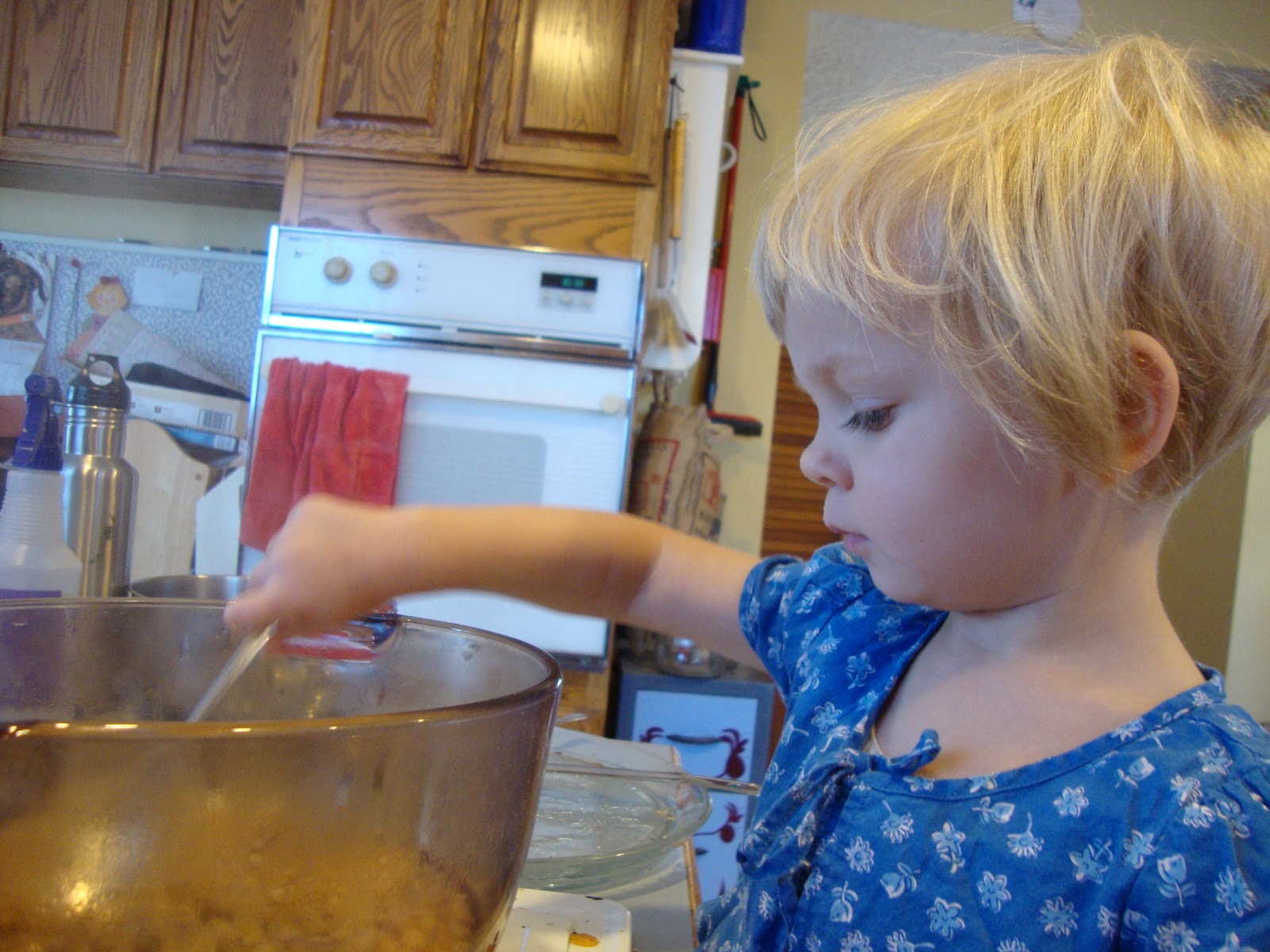
knee-deep in higher learning

Wednesday, November 2, 2011

365 TV-Free Activities: Crime Bites


We've been plowing through our year-long commitment  and today, our dining room became a small restaurant.  But first, I whipped up a batch of Play Modeling Clay (advanced, idea #248)


This is 3 cups of flour, 1 1/2 cups of salt, 1 tablespoon of cream of tartar, 3 cups of water, and 2 tablespoons of cooking oil, all colored and cooked up.  After combining the ingredients, I poured the runny results into a series of small containers, so I could color and cook them up separately.  Once I added the desired amount (I tend to double that) of food coloring, I heated up the pasty mixture over medium heat, stirring constantly, until it started to become IMPOSSIBLE to stir.  Plopped it onto a cutting board and let it cool; it was ready to use after a few minutes of kneading.

I chose red, green, yellow, and brown for my modeling clay colors, because I thought they would be the best for making a luscious banquet such as the one you see before you. 


O, the whimsy! We all made a contribution. Tiny fries with tiny ketchup. Pizza! Chips! Fruit! A platter of chocolate chip cookies. A cob of corn, covered with individually sculpted kernels. And, how will somebody eat that crisp healthy salad in the blue bowl? Why, with the tiny red fork, of course.

Okay, so we got our food all set, now time for restauranting (idea #263). Instead of making a menu, Thomas' restaurant offered cafeteria-style dining, with a fun family atmosphere. You like it? Grab it, and pretend to eat it.  But first, you must pay with cash.  So, hit the ATM if all you brought was plastic. 

(Currency Games idea #146)  Yesterday, Henry made this little ATM with our big abacus and paper. He made a card, and money to go with it, all from cardstock. In the Currency Games activity, kids make money, decorate it symbols, and devise a value system. There is the basic unit; Henry went with the dollar. From there, the other bills were quantities of dollars, and the coins were fractions of a dollar, as it goes with the U. S. currency system. It could be switched around or the unit could be called something else. Something silly, like slap.  "That'll be 50 slaps, please." or "Hey buddy, can you spare half a slap?" 
Anyway, back to the restaurant.

Thomas was the proprietor/waiter and was happy to bring George anything that caught his eye, and refill his drinks, of course.


mmmmmmmm


mmmmm?

I wish this story didn't end with a heinous crime, but while George was enjoying his salty supper, a local thug wrecked the ATM and made off with all of the cash.  Thomas needs to hire some security, if he doesn't want to lose customers.  I nominate the pig.  She's strong, has a mean streak, and will accept anything edible as payment.  Even play dough salad.

Tuesday, November 1, 2011

Brainstorms: Thanks

This is a Blue Hubbard Squash, we grew in the garden.

Here is the same Blue Hubbard squash, with rock'n roll fingers.  Thanks, Thomas.


Here is that same Blue Hubbard squash, with a turkey head.  Did I mention this squash will probably be featured prominently in our Thanksgiving dinner?


Here is Mae, calling it a chicken, only she says "chkn".  She is also eating leftover pumpkin stew out of an old hummus container.  I feel like I might be losing you here.  Perhaps, a little background:

See, every year, one of my good friends, also a mom and lover of learning, does a November-long activity with her two beautiful children, leading up to Thanksgiving Day. I am lavishing her and her children with praise, because I want her to know that we are not mocking her wonderful project, with our bizarre recreation of it.  Every November morning, her children offer one thing they are thankful for, to be written on a paper turkey "feather" and added to the back of a turkey figure. This is a little like it, only hers are much cuter, with the turkey facing you, and the feathers made from a variety of pretty paper.

So, I told the kids about it, and they felt we should do it.  Only one thing, we don't eat the celebrated bird on the holiday of dubious origins.  We do eat a lot of stuff we like, however, and will probably slay and prepare our vegetables with a sense of gratitude.  And so, Thomas fashioned a paper and duct tape turkey head, and Hubbard, the Blue Squash of Thankfulness was born.  He sits on our shelf, accumulating daily feathers, bearing the names of things we love.  Today was day one.  Mae is grateful for Pandora, the online radio that fills our house with cumbia music all day (my thing to be grateful for, coincidentally).  George thanks Netflix for Kipper, Henry is thankful there is pastry in the world, and Thomas appreciates a little thing known as Mankind.  I can't wait to see what they say tomorrow.

Thursday, October 27, 2011

365 TV-Free Activities: Treasure Map

Day 141: I decided we'd do activity # 335 today.  Henry was my ally, but you shall see, alliances among pirates were made to be broken!  

I'll take a little break from cackling madly and explain.  Henry was my loyal little henchman,following my orders to take a mysterious metal box to our local playground, hide it there, draw a map of its whereabouts, tear the map to pieces, and hide the shreds.  Meanwhile, I got Thomas, Mae, and George ready, and we headed down to the playground.  When we rejoined him, Henry played a little game of Warmer and Cooler (idea # 135: Hide It: extra credit!) to help Thomas find the map pieces, which were hidden here and there.  
 In no time, Thomas pieced the map together and figured out where to find the treasure.  X marks the spot!
 To the tree!

 He found the metal box, hidden under a weed-blocking fabric, under bark mulch.  Inside, treasures galore!  Chocolate!  Jewels!  Magic rocks! And a basket.  It made an exhilarating metal jingle when shaken.  Could it be?  Real treasure inside?

Drat!  Metal buttons!  And a cryptic note, mocking their trusting foolish ways.


And, with a loud pocketful of clanging coins, I broke out in a mad run.  Freaking out townspeople at the local playground,  Just another day in the BU.  That's Henry, hot on my heels.


He caught me!  (surprise, surprise), and managed to fish the treacherous booty out of my pocket.  He and Thomas then took it to the local grocery store and spent it on snacks and beverages.  Just like real pirates.


Tuesday, October 18, 2011

The Muddy Kitchen: Cooking With a Toddler

I'll begin by saying, this post does not contain a recipe. If you want to make the same thing Mae made yesterday, buy Vegan on the Cheap, a cookbook we picked up recently, and make the Moroccan Chickpeas With Couscous, only make it with quinoa, which is what we did.

No, this post contains a recipe for a budding chef; How to Make the Perfect Young Gourmand. These are my tips on how to cook with someone who has just two crazy years behind her.


It's more fun than it sounds, I promise. You have to know your kid really well, and do things just so. But, I'll get to that later. Let's talk about why a small young tiny baby girl should be wielding knives and working near a heat source?* Because it is within their grasp, with a little help, and I believe it makes them mighty. It is my goal to see my kids familiar with the ingredients that go into food they love to eat.

*with constant, vigilant**  parental supervision. 


**bordering on panicky, but you don't want to make the air in the room full of  fear chemicals, so try to keep cool.


So, yesterday I decided it was high time our youngest child, Mae, stopped her free-loading ways and made us all dinner. And no Air Cakes, or Lego Sandwiches. Dinner. Something hot and filling, and you know what? Moroccan! Yeah, you tiny small little young baby girl, make us a wonderful ethnic vegan dish, because mama has a blog and this would be the ultimate. Get to work.


1.  Start early: Hold the Angst

When cooking with a toddler, you don't want to wait until 3pm (aka The Crankening) to start. If your li'l chef is no longer napping daily, that's still a bad time, for two reasons: 

  a. They are usually very tired at this point in the day if they haven't napped. Exhaustion can greatly increase the chances that your cooking kid could get hurt.  

 and 

 b.  If  it ends up being for the best that the attending adult throws in the towel, puts on some Netflix instant streaming gobbldeygook, and takes over, finishing the meal, said adult still has to do it while said toddler is perhaps ignoring the Netflix gobbldeygook, and is clinging to the lower half of her mom's legs, wailing into her knees.*

*By the way, if this happens, quit stirring. Turn off the stove, heat up the oven, and pop in a frozen pizza. But, first, top it with something from the garden and take a picture. You know, so you can still blog about it.


Here is Mae in the morning, starting the garbanzo beans. You might call them chickpeas, but I don't. I did, however, call Mae a Chickpea, and I enjoyed that very much.

They're dry, raw, and perfect for scooping from one container (a bowl) to another (a large cooking pot).  I gave her a pitcher of water, and placed one hand on the handle, the other wide against the front of the pitcher, and helped her pour.  I have made a point of acquiring small and child-friendly tools for our kitchen over the years. However, a liquid measuring cup, filled and emptied several times would do just fine.

With tasks like pouring a full cup of water into pot, I introduce it in phases. At first, I model how to do it. Next, I transition to the child doing the action once, with my hands also there, doing all the work.  Finally, I let go and let the child do it on her own, and make sure I know where the nearest towel is.  Practice saying "We'll wipe it up!" if they spill, and they probably will. But, they learned a lot from that spill, most likely, so let them have another go, right away. If children don't fear mistakes their determination can shine, and they usually show a lot of progress. Children learn from their mistakes very quickly, when they're motivated.  

After she had covered the beans in water, I dumped a little pile of salt on her palm and told her to put it in the pot, which she did. Then, I handed her a spoon after stirring for a second and said, "Stir it. You're making dinner." She was totally on board with that! So, we went up to the stovetop.  

2. Using the Stove*: Using Some Sense

 *At your own risk!  Consider for yourself whether you and your child would have a good experience working around a hot stove top.  If you feel you would be too nervous, or your child would get hurt, (or both, obviously), or that all of this Make Your Baby Cook Dinner stuff is nonsense, don't do it. )


I put the pot on a burner, scooted up a chair, turned up the heat, and handed her a long-handled spoon. We have been teaching her "hot" and "be careful" for a long time now, so she was hip to it right away. The burner warmed slowly (perhaps the only plus to having an electric stove) so she could feel the heat intensifying gradually.  I noticed her becoming more and more aware of the heat, keeping a distance from the burner as it got more dangerous. This is not to say that she is anywhere near ready to be near a heat source of that magnitude without a parent right there, free-hands, and fully attentive, at her side the entire time. But, I could remain calm around her and give her instructions, like "Stir it, and now pour this in.  Stir it some more.  Be careful. That's hot." while there was bubbling and heat and sizzling and all of that.

3. A Lot of Here We Are and There We Are

Mae's major contribution to the preparation  of tonight's dinner was Moving Small Bits From One Location To Another.


When putting beans in a pot, or chopped nuts in a pan to toast, or mixing a bunch of ingredients in one bowl and dumping it into a larger receptacle , the main thing a little kid can already do is pick stuff up and put it somewhere. And they love it!  Plus, I noticed she was trying to mimic the way she has seen me scoot little crumbs together with the side of my hand, like a squeegee on the cutting board. That took some doing.


Little kids also love cutting parsley with scissors. Do with that what you will. 

4.  Onions: Give Baby a Break

Don't make the little child cut the onions. Do it for them, offering chopped onions, if called for, when needed. The end.

5.  Math: Sneakin' It!

Yeah, yeah, the measuring cups. We all know how kids learn fractions by using measuring cups and spoons. Only problem is, try to explain the marvelous world of fractions to a toddler. They don't care! You know what they do love? One-to-one correspondence, which came in handy when we didn't feel like setting the table.  We handed Mae four bowls and told her to put them on the table. She did. Then, we handed her four spoons and she knew she was supposed to put one with each bowl, and she did. Did you know she just demonstrated mastery of a kindergarten grad-level concept there? boom.


 Extra Zen Credit Points: She also shuffled meticulously across the vast kitchen floor with brimming cups of water, and lifted them above her head to the top of the table, spilling nary a drop. Four times. That demonstrated a level of focus and commitment I'm not sure even I possess. It was an inspirational little moment.

6.  Garnish: Love Sprinkles


You don't need garnish.Or do you? Does your soul need song? Does your heart need art? Does your tongue need love?  If you answered "yes" to any of these questions, you might consider garnish. It's a way to celebrate life by sprinkling something on your food. Something delicious. Freshly-snipped herbs, toasted nuts, grated cheese, sliced peppers: garnishing a lovingly-made dish is an easy way to convey to your culinary kid that we are trying to have some fun here.  This is fun. Sprinkle Away! Life Tastes Good! Look at that! You just made dinner!

Thursday, October 6, 2011

The Muddy Kitchen: Bread Pudding Pumpkins

 Right now.  This is the time.  The pumpkins are ripe, the bread is stale, and the kids are hungry.


This recipe is for just one little pumpkin, or li'l punkin, if you will, and I hope you will.  Click the picture of this recipe to see it enlarged.

Of course, we made six of these, but could only eat three.  So, when you're reading some of my crazy quantities, keep in mind, I took the above recipe and multiplied it by six.  And that ended up being twice as much food as we needed!  But that's because we added ice cream, which isn't called for, but was, in a way. 
First, you seize the moment, and carpe the pumpkin.  Here George tops it with a special serrated tool from a pumpkin carving kit.  As we worked, I regaled the kids with horror stories of The Days Before They Made Pumpkin Carving Kits.  "It was just the big knife. And the big spoon!" I said, in my best creepy voice.   "You'd stab your kitchen floor, every time!"  I don't think they believed me, but it was true.  All too true.  
Each kid has that first year, when they can do most of the pumpkin work on their own, if left alone.  This was George's year.
Once your gourds are cleaned out, score the insides with a knife.  We have a set of knives we let the little kids use, because they're somewhat effective, but not likely to cause an injury.  The red-handled one Mae is holding here is serrated, but not too rough or sharp to the touch; perfect for grooving up the inside of a pumpkin. 
They're ready for sauce, and baking, but first let's get the younger kids tearing up the bread.  That'll keep them busy while we deal with tricky things like melted butter.  Right?  


 This is just a day-old baguette, and George and Mae have been given orders to tear it to shreds.  Only one problem.
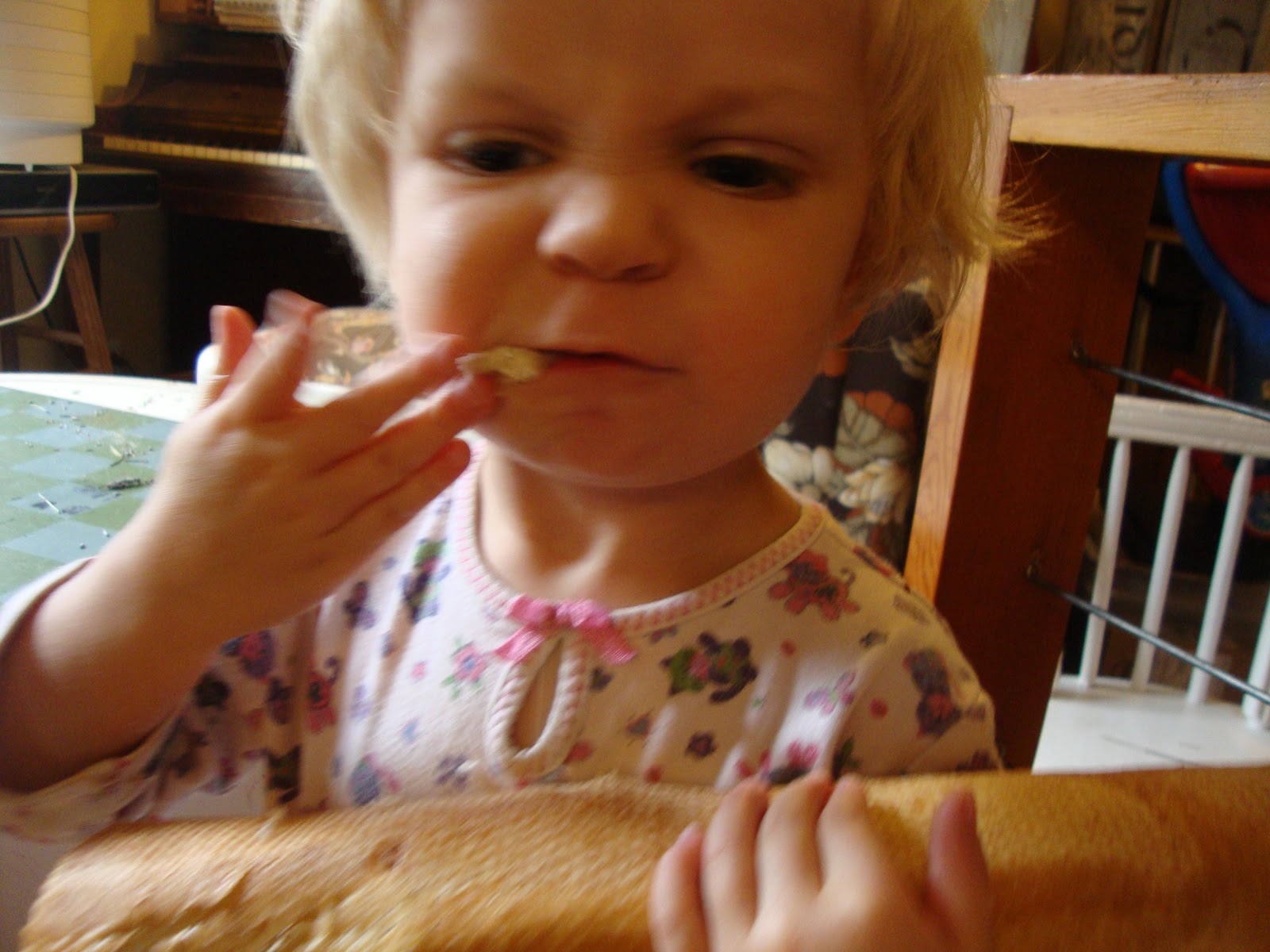
We got an eater here.  For goodness' sake, at least try to be a little sneaky about it.  
Seriously, how am I supposed to walk away from this? 
Okay, I guess most of it ended up in the pot.
ope!  Hey!
C'mon, I need to go do the sauce.  Otherwise, this is just a pot of shredded bread and some raw pumpkins, and nobody wants that.  
Bake these for about thirty minutes after bathing the inside of the pumpkin in a mixture of Paula Deen proportions of melted butter, brown sugar, cinnamon, and maple syrup.  Toss the remaining butter sauce over what's left of your baguette, and a couple of cups of raisins, and a couple of cups of chopped walnuts.   
When the pumpkins are good and squishy, fill them with the bread mixture and pour over it with a whisked-together 2 c. milk, 12 eggs, and 4 cups of grated cheddar cheese.  At this point, even Mrs. Deen herself would walk out of the room in disgust, but press on!  Pour this mixture over the bread mix, filling the pumpkins, and put them back in the oven for 45 minutes to an hour.  Basically until they look like this:  

Let them cool, cut them into halves, slices, or wedges, peel off the skins and go to town.  Just make sure you have a plan for the leftovers.  

And I'm not saying another word about the scoop of vanilla ice cream that got served with each wedge.  Not a word.  Make peace with your own demons on that one.  


Saturday, September 24, 2011

Brainstorms: Bird Brains

How did we get here?  I mean, I know that we woke before dawn and drove for over an hour to a site I read about on the internet, for a field trip that was open to the public, but what on earth for? 


This


 And this


Blue Jay?  Think again, that's a Stellar's Jay.


 It is Beaver Creek Natural Area, and it's a bird-watcher's wonderland. 

Oh, did I forget to mention?  We're totally bird watchers now.  Thomas got us into it.  He makes the most beautiful bird drawings, which gave me the urge to tell him about John James Audubon .  This led to looking up the The National Audubon Society , where we were able to enter our zip code and find our nearest Audubon Society's chapter.  Their site advertised a Yaquina Birders and Naturalists field trip that cost nothing, was open to the public, and happened on a day we had free.

So, naturally, we met up with a wonderful group of birders and naturalists and accompanied them on their morning hike through the marsh.  The leader was friendly, knowledgeable and happy to see a kid there.  That made us happy.  As a matter of fact, everyone was happy to see a kid there!  They loaned us their high-octane supersonic binoculars that made every far-off speck into a scene from National Geographic, pointed out native plants, and offered a wealth of information about the lives of the birds we were observing.  It was a privilege to be there with them today.

Monday, September 12, 2011

365 TV-Free Activities: 100 Days of This!

Here we are at Day 100, and I have for you dueling tales, depicting two brothers' dealings with a mysterious creature. First Henry came to me with his story of the The Chickenfish King:

Last night, Thomas and I were down in Nehalem Falls Creek. It was then that Thomas learned about the mythical Chickenfish. The Chickenfish is a bright white fish that has feathers instead of scales. It swims the way a penguin does; its feathers are good swimming feathers.

Thomas announced that he did not believe in the Chickenfish. All of a sudden, the water rippled and we knew that Thomas had angered the Chickenfish King. I told Thomas that we had to go down to the Chickenfish King's lair, and give offerings so that he would not disrupt our picnic. We ran across the rocks and jumped over logs. We climbed mountains and slid down into ravines, until finally, we reached the pond of the Chickenfish King.


We saw a little plant growing beside the pool. We decided the leaves of this plant would be enough of an offering for the Chickenfish King. We weren't sure if he was happy or not, but we saw in a ripple in the water again and we started to run. It was when were running across the rocks that Thomas slipped. Luckily, he caught himself, but hurt his hand. I carried him back to our picnic and lay him down. I saw another ripple in the water. The Chickenfish King was happy after all.
by Henry Laszlo


I was incredulous, and as I transcribed his words, I thought, Thomas will not like this. I said so, but I was instructed to type and remember my place. Thomas was not to hear about Henry's version of the tale of their quest. I pled with Henry to allow me to record Thomas' version. I was granted my wish and Thomas came to see me. When Henry wasn't looking, I said, "Now's your chance to tell your side of this story, which Henry has done, and he's carrying you at the end." So, Thomas gave his side of the story:

It was a gloomy day in summer. Fall was coming up, and me and Henry were just running around on the rocks. We heard a high pitched squeal and a ripple in the water. Me and Henry said, "It's just a pigletfish." But then, a bigger ripple and Henry said, "Oh no! Chickenfish" And I said, "No way! Run!"

And we came to a small creek with water and huge ripple and the water splashed up at us and the Chickenfish King arrived and we ran for our lives. We thought of an idea and we made an offering to the Chickenfish king, we ran away, I fell and hurt my hand. Henry fell and hit his head on a rock, so I had to drag him all the way back the site.
by Thomas Laszlo


The emergence of The Chickenfish King made me think of one of The Activities, from The Book, so here's idea #101: Fantastical Creatures

Introduce your kids to the mythical creatures in reverse. Instead of showing them a picture of a sphinx or a unicorn and saying "That is a sphinx or unicorn", describe the attributes of a sphinx or unicorn and ask your child to draw what they think that would look like. Unfortunately, Henry and Thomas are well-versed in their mythical creatures and their results are pretty spot-on. I need to check that chimera.


The above picture is Thomas' satyr and centaur, and the chimera (lion head, goat body, snake tail) below is Henry's work.


Afterward, you can look up real pictures of the mythical creatures and everyone can have a laugh, I guess. Just don't be hurtful. I couldn't draw a decent unicorn until I was well into my teens, and I even knew what they were supposed to look like. If you say, "A unicorn is like a horse with a horn sticking out of its head!" and your child draws what looks like a trombone with hooves, you know you're doing something right. My unicorns always resembled long-haired pigs who had recently suffered a head injury, sometimes with wings