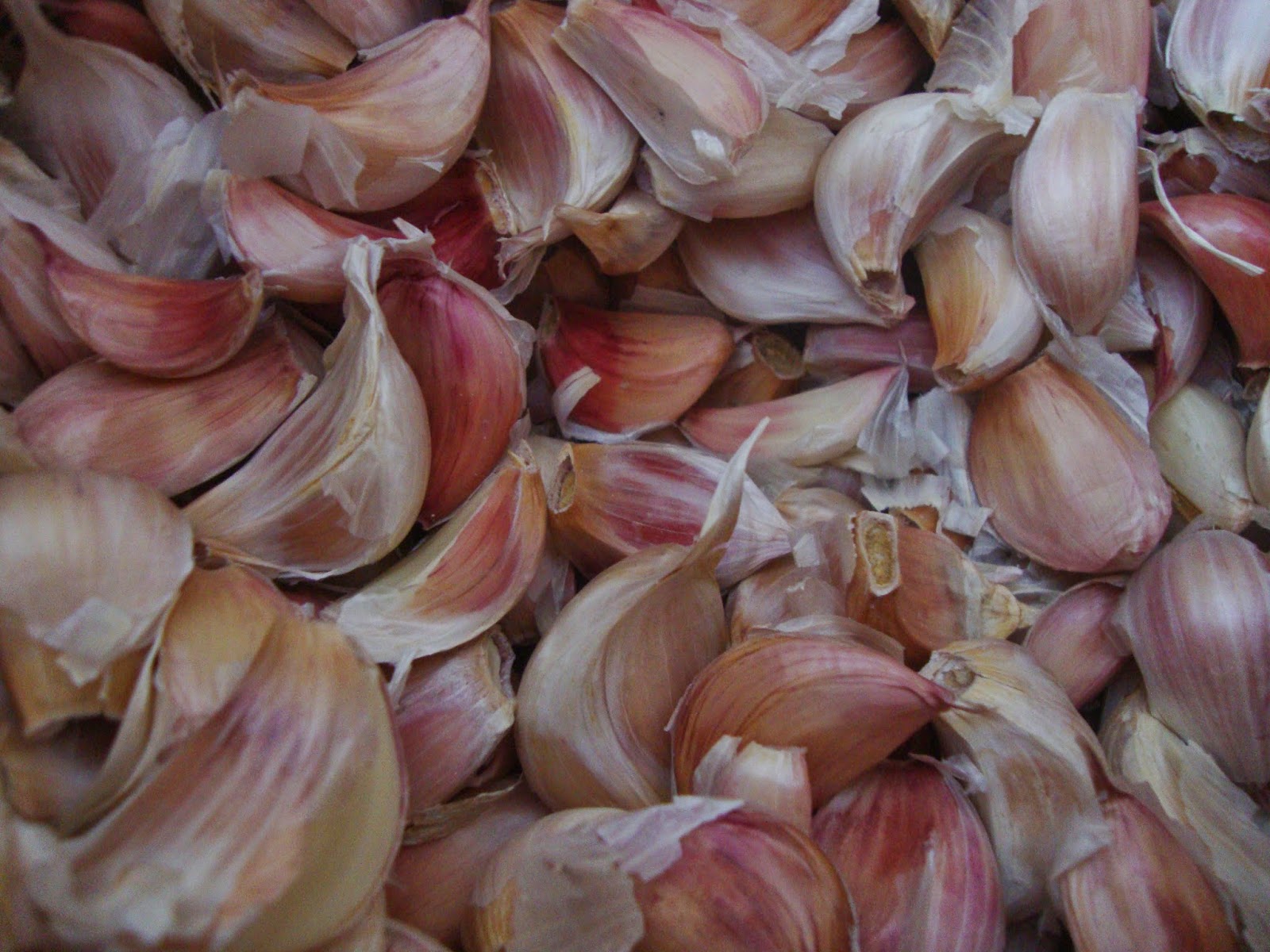
With each year, I feel my thoughts throb in time to the changing seasons, like a calendar with concepts instead of month names. For me August, September, and October have become Abundance, Acceptance, and Gratitude. This is when I can pull my weight in Asian pears from a tree whose limbs are touching the ground, groaning from all the plenitude of fruits. It is when the bright flowers of early summer are replaced by brown stems and pods full of promises for next year. It is when I clean and sort over 1,000 cloves of garlic for planting and feel like a queen, counting her rubies. It's like an annual crescendo, all the rewards of earlier work, a million wishes coming true at the same time.
Abundance:
After late summer's growing and gathering, early fall is always when I worry about where to put the latest pile of food I have harvested. I have to think in quantities of many gallons at a time. I know that come what may may come, so it just feels good to have A LOT.
But I'm not just talking about storing more shallots than one enormous family should eat in a winter. Our continuation as a species among species is not reliant on any one trait (strength, speed, size, having the most shallots, etc.) but in being ready for anything. Asteroids, Ice Ages, Ebola Zombies From Space: the one thing we all know is that we don't know what's next. Like squirrels preparing for winter, we know we should guard every useful morsel, but who knows what might be called for? What might be deemed useful? In a sense, because we cannot know what we will need next, appreciating diversity ends up being the only winning strategy: believing in the potential value of all things.
Acceptance:
Making my life a little bit fuller lately is a part-time job, working for the local school district. I'm a Special Education/Special Care Assistant at an elementary school, and honored to be part of the team that walks out to meet the short buses in the circle drive every morning.
Our task: to help each child living outside of life's various conventional parameters have the best educational experience possible.
Setting aside the belief that each one of us is a special snowflake for a moment, it is evident, when gathering many children from your town, that some of them are
more special. Maybe what sets one apart is visible from the outside, like her facial features, or his limp. Maybe it's not, like that child who cries inconsolably when overwhelmed, the one who cannot (and maybe should not) sit in a chair for more than ten seconds at a time, or the one for whom all the letters look backward or out of place.
It might be a little simplistic to group them all together when they are each a walking lesson in individuality, but group them together we must. That's how we can help each one of them get more out of school. Due to the constraints of managing many young people in an enclosed space, the norms within a school can be a little narrow for some kids. With the help of a team of special educators, special students might find that the cookie cutter of classroom life can bend a little, to accommodate them, where they are; allowing the differences they bring to enhance the education of the other students in their class.
Remember that belief we set aside a couple of paragraphs ago? About us all being special? It's true. While categories can be useful, it seems sometimes that they just exist to be selectively ignored or applied. Special. Average. Different. Normal.
We can live so many ways and make any number of choices during our lives. It's best to respect differences, even if it some of them make standing in line or taking a state assessment more difficult. That's just a matter of what the environment demands. Change the demands, you change everything. Kids who struggle in one system thrive in another, and vice versa. Special kids bring a new human dynamic, a unique contribution, if those in their environment are able to see their potential worth.
Relativism, FTW.
Gratitude:
When our George was labeled as having special needs, at the age of four, it really made me think. I understood that his diagnosis was made in order to give him access to help from people in the same profession I have just joined. I also knew why they wanted to assess him. Having been around enough four year old boys by then, I knew that, while each one of them was his own little dude, George was different from all of them in a way they were not different from each other. He could add together large numbers and had an amazing memory, but he rarely looked you in the eye and made chit chat. He preferred to state empirical facts in a monotone, adorably husky, voice.

At preschool, he was very quiet, almost never speaking, causing them to suggest the assessment. He had a complete physical, combined with vision and hearing screenings, and in-depth sessions with speech pathologists and seasoned educators. They wondered if he was autistic, suspected something on the spectrum, but eventually settled on the special needs diagnosis.
Yeah, acceptance and all that, but when your kid gets such a label, you might find yourself looking for reasons why, things you could have done differently. My mind sought high and low through my memory for things that he missed out on, being the youngest of a threesome. Like most new mothers, I trotted my first-born, and second-born (to a lesser extent), to classes and community activities of all sort. George had gotten a lot less of that, as I was busier by the time he was ready for such pastimes. Resolved to boost and enrich his social life, I looked up the next time and date of story time at our library. I thought it would provide a nice opportunity to spend time with other kids. I might have been hoping that he'd copy them a little.
It was just the two of us walking into the bright children's section of the library, as the children's librarian began her program for the day.
A fantastic place, run by a talented and dedicated children's librarian, don't get me wrong.
With no other children to mind, I was free to ruminate on things I'd heard the specialists say about George as I watched him watch the children's librarian read to the townschildren.
The librarian noted that some of the kids in the group were moving around too much. "GOODNESS! Everyone has such a case of THE WIGGLES! We're going to need to use the WIGGLE BAG!!"she chirped. Soon, she was stooping and holding out an empty black cotton bag to each kid, singing, to the melody of "If You're Happy and You Know It, Clap Your Hands."--"Put your wiggles in the bag, put them in!" Each kid played along gleefully, wiggling their bodies, then tossing their invisible wiggles into the bag, and sitting still.
This is the sort of thing my other sons would have owned, convulsing convincingly and slam-dunking wiggles in an effort to outdo all the other wigglers. Instead, George stared at the little moment of spontaneous improv group theater until the bag got to him. He moved his legs perfunctorily and then flung his hands toward the opening of the bag, with a facial expression that said, "Let me get this straight. We are to wiggle, and then we are to pretend to put something in the bag which we do not put in the bag because it is nothing. Then we are still. And this was fun."
In that moment, I felt a swell of appreciation and kinship for my special son. His logical mind and his sweetness. He was trying, bless him, to give us all what we wanted, whether it made any sense or not. If I were a little more dramatic, I might have scooped him up and left at that very moment. Instead, I just made a mental note to let him lead the way more often.
When someone doesn't play along, it can make others nervous, and desirous to change that someone, compel them to conform. But what if we need to have our conventions reconsidered by some in our midst?
Would different people be valuable and important then?
We have all become quite convinced of the importance of our social norms,
but that doesn't mean that there isn't something a little asinine about them.
Maybe it's safer to revel in the subjective, as long as you are reminded that it's just that: subjective. It is appealing to you,
and weird to someone else.
For his sake, for my sake, and for the sake of all people, I didn't want George to stop being different from everyone else. We need him and everyone else like him and everyone else unlike him.
This experience, and a few others, made me decide that George might do very well in an environment more suited to him than his local school classroom. We took the fish out of the tree, so to speak, and decided to unschool away. Let him do what he wanted with his time.
He has spent the last five years, drawing, tending to a revolving menagerie of pets, playing computer games, inventing games with his sister and friends, watching Spongebob, cracking jokes, playing the piano and violin, reading Captain Underpants, playing chess, dancing, writing lists, and riding his bike, among many other things.
He taught himself to read and write, is always researching the solar system, and does math just for fun, often making up problems for himself and solving them.
Those things that made his teachers notice and examine him also make him incapable of telling a lie. He wouldn't know how to begin to manipulate another person, nor can he live with doing anything less than his best effort in any chosen task. Is there still something very distinct about the way he sees the world and expresses himself? Something noticeably unlike everyone around him?
Thankfully, yes.